
The Vietnamese government has issued Decree No. 293/2026/NĐ-CP, setting out the rules for implementing the Hague Convention Abolishing the Requirement of Legalisation for Foreign Public Documents (the Apostille Convention) in Vietnam. Both the Convention and the Decree take effect on 11 September 2026. From that date, qualifying public documents exchanged between China and Vietnam may be legalised using an Apostille certificate, eliminating the need for consular legalisation.
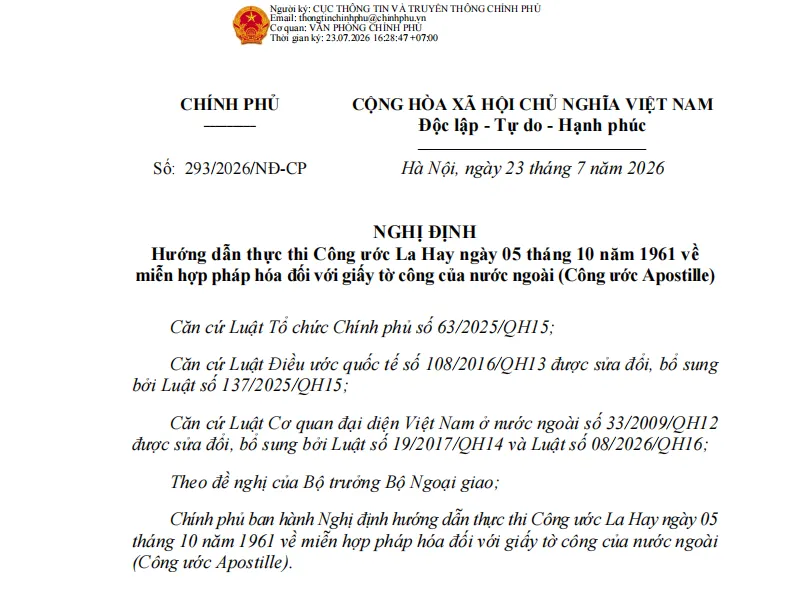
Original source: https://datafiles.chinhphu.vn/cpp/files/vbpq/2026/7/293_2026_nd-cp_23072026_1-signed.signed.pdf
I. Background
Vietnam deposited its instrument of accession to the Apostille Convention with the depositary on 31 December 2025. On 23 July 2026, the Vietnamese government issued Decree No. 293/2026/NĐ-CP, specifying the issuing authorities, application procedures, document verification, transitional arrangements and electronic mechanisms for Apostille certificates (commonly known as “Apostilles”).
The Convention and the Decree enter into force on 11 September 2026. Thereafter, qualifying public documents exchanged between China and Vietnam can be legalised via Apostille, without the need for consular legalisation—helping to streamline the cross-border legalisation of medical device registration documents.
II. Changes to the Legalisation Process
| Item | Previous Consular Legalisation Process | New Apostille Process |
|---|---|---|
| Legalisation steps | Notarisation or commercial certification → Certification by China’s Ministry of Foreign Affairs (MFA) or local Foreign Affairs Office → Legalisation by the Vietnamese embassy or consulate | Notarisation or commercial certification → Apostille issued by China’s MFA or local Foreign Affairs Office |
| Consular legalisation | Required | Not required |
| Indicative timeframe | Approx. 2–4 weeks | 7–10 working days recommended |
| Key change | More steps, longer processing time | Simplified process, shorter timeframe, relatively lower cost |
The new process removes the Vietnamese consular legalisation step, helping to simplify procedures, shorten processing times and reduce legalisation costs. It is important to note that an Apostille replaces only the consular legalisation step—it does not automatically exempt documents from notarisation, Vietnamese translation, or medical device registration requirements.
III. Documents Subject to Legalisation
Documents requiring legalisation in Vietnamese medical device registration include:
- Certificate of Free Sale (CFS)
- Letter of Authorisation (LOA)
IV. Requirements for Using Foreign Documents in Vietnam
Public documents from Convention member states with which Vietnam has an applicable relationship may be exempted from Vietnamese consular legalisation once a valid Apostille has been obtained. However, the following still apply:
- Documents not in Vietnamese must be translated into Vietnamese, and the translation must be notarised or legalised;
- The Apostille must be issued by the competent authority of the country in which the document was issued;
- Forged, altered or revoked documents may be rejected.
V. How Are Transitional Cases Handled?
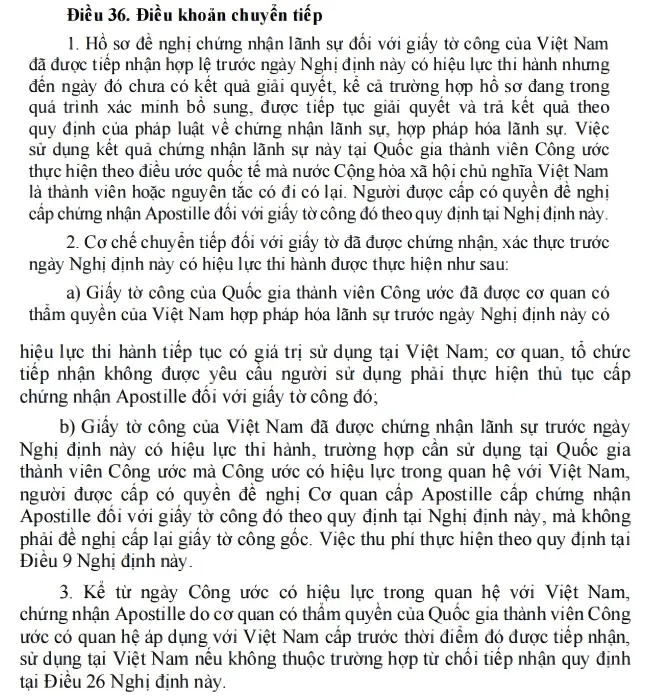
The Decree provides that:
- Consular legalisation applications already accepted but not yet completed before 11 September 2026 may continue to be processed under the original procedure;
- Foreign public documents that have already completed consular legalisation before the effective date remain valid in Vietnam and do not need to be re-legalised via Apostille;
- After the Convention takes effect, valid Apostilles issued by member states before the effective date may also be used in Vietnam, provided they do not fall under statutory grounds for rejection.
Accordingly, valid documents that have already completed consular legalisation do not all need to be re-issued with an Apostille.
VI. Electronic Apostilles to Be Rolled Out in Phases
Vietnam will implement electronic Apostilles, electronic registers, QR code verification and fully online processing in phases. Before the Apostille information system is fully operational, paper Apostilles will continue to be issued; the date the system goes live will be announced separately by Vietnam’s Minister of Foreign Affairs.
VII. Recommendations for Medical Device Companies
Companies should confirm in advance the legalisation and Vietnamese translation requirements for CFS and LOA documents. For new registrations, Apostilles can be obtained under the post-effective rules. Before submission, it is advisable to confirm document formats and acceptance requirements with your Vietnamese authorised representative to avoid delays in the registration process.
Vietnam’s accession to the Hague Convention further simplifies the cross-border legalisation of medical device registration documents, creating new opportunities for Chinese companies to accelerate their expansion into Vietnam and Southeast Asia. Vietnam is also one of the few countries that recognises China’s NMPA registration certificates and applies a simplified registration pathway. For companies that already hold NMPA registration and are planning to expand overseas, Vietnam is well worth considering as a priority market.
Guorui Zhongan has two wholly-owned subsidiaries in Vietnam and can provide one-stop services including Vietnamese medical device registration and authorised representation, helping companies enter the Vietnamese market efficiently and compliantly. If you have any related needs, please feel free to contact us.