
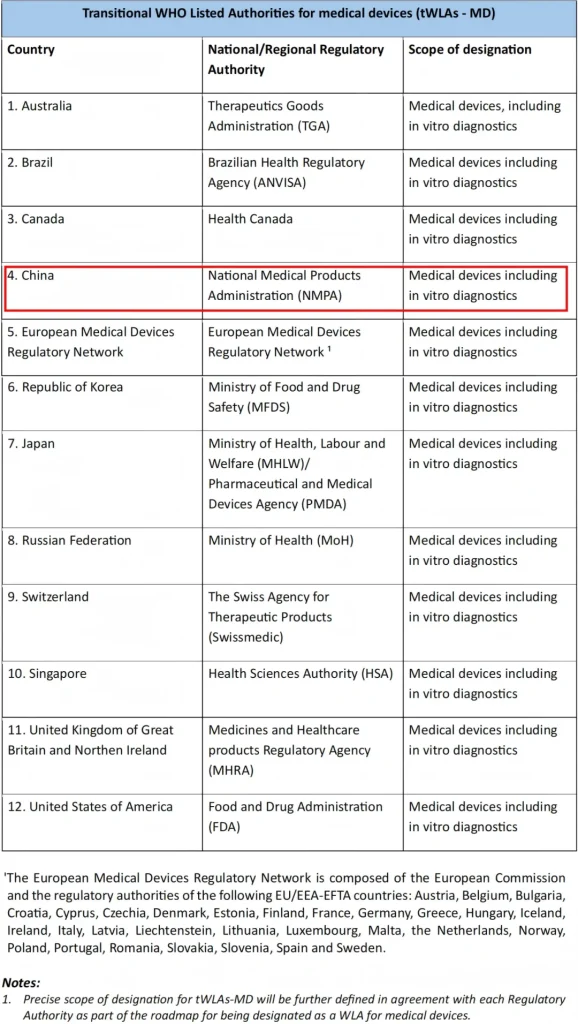
The World Health Organization (WHO) has published its first list of transitional authorities for medical devices, with China’s National Medical Products Administration (NMPA) successfully included.
The release marks an important step toward strengthening regulatory reliance and international confidence in medical device regulatory systems. As regulatory authorities increasingly recognize and leverage each other’s assessments, inspections, and regulatory expertise, the pathways for medical device companies seeking international market access may evolve significantly in the future.
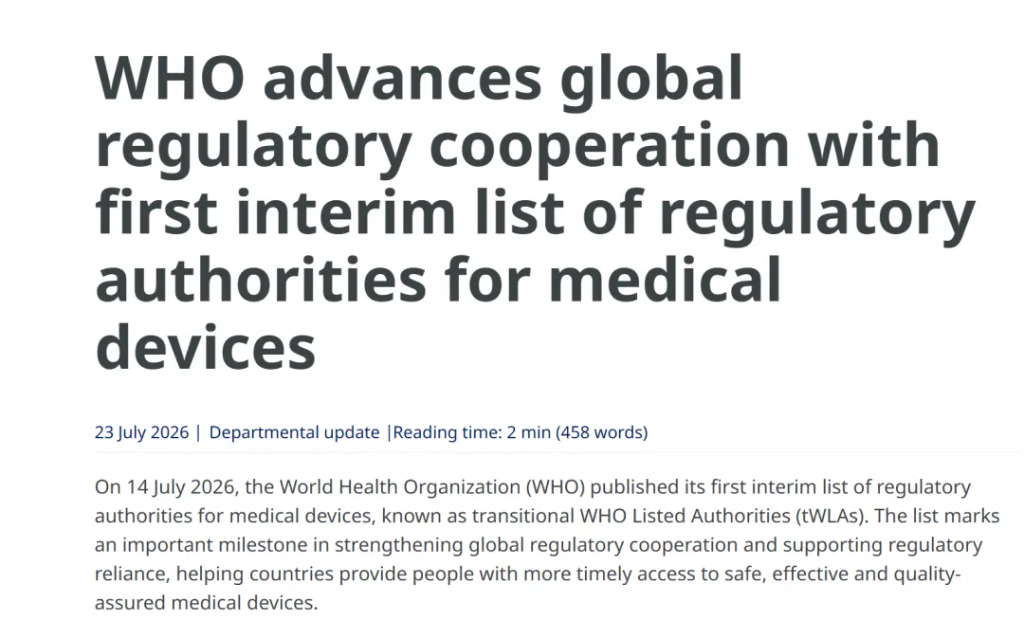
Original WHO document:
Listed Authorities for medical devices (tWLAs-MD) as of 1 July 2026
1. Why Has WHO Published This List?
As medical technologies become increasingly complex, regulatory authorities are facing growing demands for technical expertise, resources, and assessment capacity. Conducting fully independent and repetitive reviews of the same products can consume significant regulatory resources and create unnecessary duplication.
To address these challenges, WHO has been promoting the concept of Regulatory Reliance.
Under a regulatory reliance approach, a regulatory authority may, under appropriate conditions, take into account or rely on the regulatory assessments, inspections, and other relevant regulatory outputs conducted by another trusted authority.
In simple terms, regulatory authorities do not necessarily have to start the entire review process from scratch when a reliable regulatory assessment is already available. Instead, they may leverage existing regulatory work to reduce duplication, improve efficiency, and facilitate timely access to safe and effective medical devices.
2. What Does It Take for a Regulatory Authority to Be Included?
Under the WHO Listed Authorities (WLA) framework, regulatory authorities are expected to demonstrate a high level of regulatory maturity and capability.
Achieving at least Maturity Level 3 (ML3) is one of the key conditions for inclusion in the WLA framework.
The inclusion of China’s NMPA therefore represents international recognition of the maturity and capabilities of China’s medical device regulatory system.
For Chinese medical device manufacturers, this development is particularly noteworthy because it further strengthens the international recognition of China’s regulatory framework.
3. What Should Medical Device Companies Take From This?
It is important to understand that inclusion on the WHO list does not mean that products regulated by the listed authority will automatically receive approval or exemption from regulatory review in other markets.
According to WHO, responsibility for using the list, as well as the final decision on whether and how to rely on a listed authority, rests with the relevant user—such as a regulatory authority or procurement organization—and depends on the specific regulatory or procurement context.
In other words, the list should not be viewed as a “global exemption from review.”
Rather, it provides an important regulatory reference point for international regulatory reliance and confidence-building between authorities.
For manufacturers, this could become increasingly relevant as more countries and regions develop or expand reliance-based regulatory pathways.
4. When Does the List Take Effect?
The list currently published by WHO is a transitional list of WHO-Listed Authorities for Medical Devices (tWLA-MD).
According to the relevant WHO guidance, the transitional list is valid for five years, with the validity period calculated from the date on which the guidance document governing the performance evaluation process and requirements is published.
Although the current list remains transitional in nature, its publication is an important signal of the direction in which international medical device regulation is evolving.
As regulatory reliance mechanisms continue to develop, Chinese medical device manufacturers participating in international markets may have more opportunities to benefit from the growing international recognition of mature regulatory systems.
What Does This Mean for the Global Medical Device Industry?
The publication of WHO’s first tWLA-MD list represents an important milestone in the international development of medical device regulation.
For Chinese manufacturers, the inclusion of the NMPA provides an internationally recognized regulatory reference point and may create new opportunities as reliance-based regulatory pathways continue to expand across global markets.
For companies pursuing international market access, understanding how regulatory authorities assess, recognize, and rely on one another’s regulatory work will become increasingly important.
The global regulatory landscape is moving toward greater reliance, greater regulatory convergence, and stronger international cooperation.
For medical device companies seeking to expand globally, keeping track of these developments and understanding how recognized regulatory authorities can serve as regulatory reference points may become an increasingly important part of their international market access strategy.
If you have any questions about global medical device registration, regulatory reliance, or international market access, feel free to contact us for professional support.