
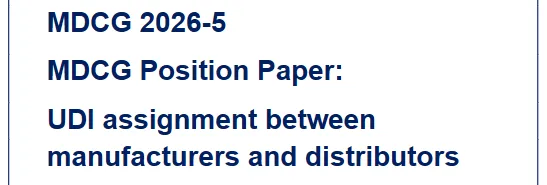
Regulatory basis: MDCG 2026-5 Position Paper, UDI Assignment Between Manufacturers and Distributors (officially published 22 July 2026)
Underlying legal framework: MDR 2017/745 and IVDR 2017/746 — MDR Article 10(7) and Article 27; IVDR Article 10(6) and Article 24; MDR/IVDR Annex VI Part C
I. Introduction
With the four EUDAMED modules becoming mandatory on 28 May 2026, the EU’s UDI registration system has entered a phase of full implementation and strict enforcement. In traditional cross-border medical device supply chains, a common industry practice has long prevailed across OEM, ODM and private-label trade models: overseas distributors applying for and assigning UDI-DI codes in their own brand name through EU-recognised UDI issuing entities.
The EU’s latest official document, MDCG 2026-5, has now overturned this long-standing operational practice, authoritatively clarifying the legal boundaries of who may assign UDI-DIs: distributors, importers and EU authorised representatives are all ineligible to independently assign UDI-DIs.
This update directly addresses compliance pain points for multi-brand private-label and own-brand exporters. All medical device manufacturers active in the EU market must immediately review their existing and pipeline UDI arrangements to avoid EUDAMED registration rejections, product withdrawals, and market surveillance penalties arising from issues of legal entity compliance.
II. Core Official Compliance Conclusions of MDCG 2026-5
This position paper does not introduce new legislation; rather, it provides authoritative clarification and correction of the UDI rules already established under the MDR/IVDR. It specifically resolves the industry misconception that “commercial private-labelling equals a change in the legally responsible entity.” The four core points are as follows:
1. The sole legally authorised assigner: only the manufacturer may obtain and assign UDI-DIs
Official wording: Only the manufacturer may receive and assign UDI-DIs in their own name from EU-recognized UDI issuing entities.
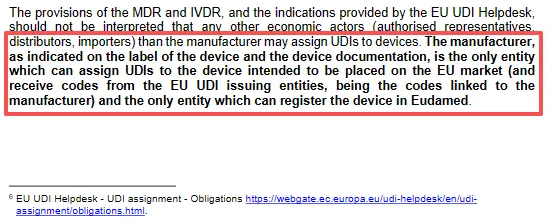
The document makes clear that a UDI-DI is not an ordinary product code—it is a unique identifier tied to the legal responsibilities of a medical device throughout its entire lifecycle. Regardless of the commercial cooperation model or whether private-label sales are involved, only the legally defined manufacturer has the right to apply for, hold and assign UDI-DI codes from EU-recognised UDI issuing entities.
Distributors, importers and authorised representatives have no UDI-DI assignment authority whatsoever. Any past practice of distributors independently obtaining UDI-DIs is now deemed non-compliant.
2. Multi-brand products may carry multiple UDI-DIs, but all must be assigned by the manufacturer
For the frequently encountered scenario of multi-brand and private-label sales, the MDCG provides a clear compliance pathway: a single medical device may be adapted to different sales scenarios—own-brand, distributor private-label, etc.—by applying for multiple independent UDI-DI codes to meet multi-brand market requirements.
Mandatory compliance requirements: All UDI-DIs corresponding to all brands must be applied for and assigned uniformly by the original legal manufacturer, and all such UDI-DIs must be consolidated under a single Basic-UDI-DI, registered in the EUDAMED system under the manufacturer’s own entity. Splitting them across distributors or importers is strictly prohibited.
3. Operational tasks may be outsourced; legal responsibility cannot be transferred
The document confirms that manufacturers may, through commercial contracts, delegate operational tasks—such as UDI code application, label printing, EUDAMED data entry, and documentation maintenance—to third parties including distributors and authorised representatives.
However, the core red line cannot be crossed: all UDI compliance obligations, regulatory responsibilities, quality responsibilities and post-market responsibilities rest with the legal manufacturer, and cannot be outsourced or shifted to third parties through contractual arrangements.
III. Old vs. New Model: Compliant vs. Non-Compliant Scenarios
Non-Compliant Old Model (Now Fully Prohibited)
- The original manufacturer produces the device but does not participate in UDI application;
- An overseas distributor independently applies for UDI-DIs from a UDI issuing entity in its own company name;
- The product label retains the original manufacturer’s information while using UDI codes obtained by the distributor;
- In EUDAMED, the UDI-DI is registered under the distributor’s entity.
Potential risks: EUDAMED registration rejection, customs clearance obstruction, non-compliance in market inspections, product withdrawal and recall, administrative penalties.
Compliant New Model (Officially Recognised by the MDCG)
- The manufacturing company, as the sole legal manufacturer, bears full UDI compliance responsibility;
- Based on brand portfolio requirements, it applies for multiple sets of UDI-DIs in a unified manner (separate codes for own-brand and distributor private-label brands);
- All UDI-DIs are consolidated under a single Basic-UDI-DI and registered under the manufacturer’s EUDAMED account;
- Distributors may be engaged to perform coding, data entry and other operational tasks, with contractual clauses expressly assigning responsibility to the manufacturer;
- Product labels may display the distributor’s trademark, but must fully retain the legal manufacturer’s information and the corresponding compliant UDI codes.
IV. Dedicated Self-Assessment Checklist for Medical Device Companies (Ready to Implement)
For OEM/ODM, private-label export and multi-brand EU sales companies, we recommend completing the following self-assessment and remediation items without delay:
- Review all products currently on sale in the EU to identify any instances where distributors have independently obtained or assigned UDI-DIs;
- Confirm that all product UDI-DIs are registered under the legal manufacturing entity, with no distributor attachment;
- Verify that multiple UDI-DIs for multi-brand products are all consolidated under the corresponding single Basic-UDI-DI;
- Review distributor cooperation contracts, remove invalid clauses purporting to transfer UDI compliance responsibility to distributors, and expressly affirm the manufacturer’s full responsibility;
- For new product development and private-label cooperation, plan UDI coding schemes in advance to eliminate the risk of late-stage code supplementation or modification;
- Complete a reconciliation of existing EUDAMED data and promptly correct any entity attachment or code classification errors.
Conclusion
The publication of MDCG 2026-5 draws a definitive line between commercial private-label arrangements and legally defined responsibilities. From the EU regulator’s perspective, brand sales rights may be licensed or private-labelled—but the product safety, quality and compliance responsibilities associated with UDI codes permanently remain with the original manufacturer.
Against the backdrop of full EUDAMED enforcement and tightening EU market surveillance, UDI compliance is no longer merely a “coding task”—it is a core market access requirement for medical devices in the EU. Exporters must abandon traditional industry habits, complete their compliance upgrade swiftly, and mitigate export risks.