
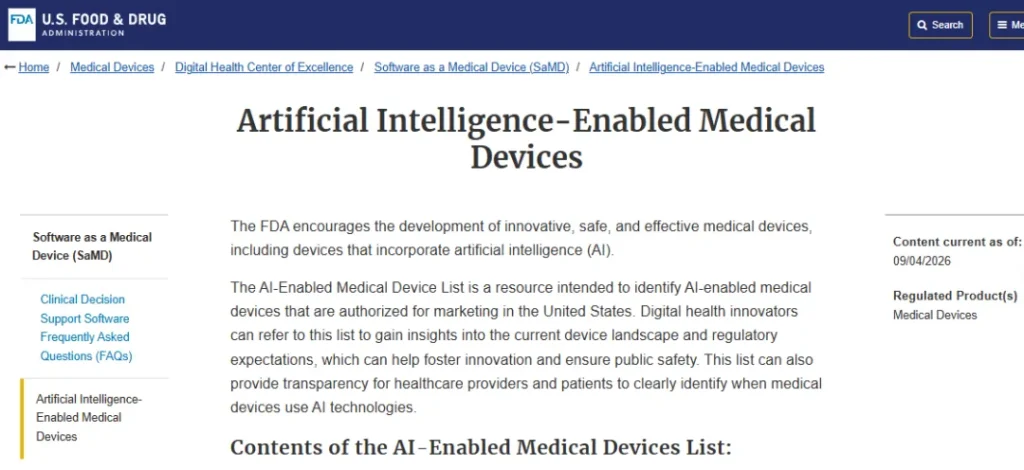
On 4 September 2026, the FDA released its Artificial Intelligence-Enabled Medical Devices List together with accompanying Excel data. The list covers 1,614 AI-enabled medical devices authorised for marketing in the United States, with final decision dates ranging from 29 September 1995 to 29 June 2026.
Original source:
I. What Is the Purpose of This FDA List?
According to the FDA, the list is intended to identify AI-enabled medical devices already authorised for marketing in the United States, providing digital health innovators with a reference point for understanding the current product landscape and regulatory requirements. It also aims to improve transparency of product information and help healthcare providers and patients identify whether a medical device uses AI technology.
Products on the list have met the applicable FDA premarket requirements. The review covers the overall safety and effectiveness of the product, as well as whether the supporting studies are appropriate for the product’s intended use and technological characteristics.
Each product entry also includes a corresponding FDA database submission number. Using this submission number, users can look up further details on the product’s approval, authorisation or clearance, as well as publicly available safety and effectiveness summaries.
II. Distribution by Major Professional Area
| FDA Major Professional Area | Number of Devices | Share of Total |
|---|---|---|
| Radiology | 1,230 | 76.20% |
| Cardiovascular | 154 | 9.50% |
| Neurology | 73 | 4.50% |
| Anaesthesiology | 30 | 1.90% |
| Gastroenterology – Urology | 27 | 1.70% |
| Haematology | 22 | 1.40% |
| Other areas | 78 | 4.80% |
From the perspective of the FDA’s major professional areas, AI-enabled medical devices are highly concentrated in radiology. Radiology products account for 1,230 devices, or 76.2% of the total, with cardiovascular (154 devices, 9.5%) and neurology (73 devices, 4.5%) ranking second and third respectively.
The list also covers other fields including ophthalmology, pathology, general and plastic surgery, clinical chemistry, orthopaedics, dentistry, microbiology, obstetrics and gynaecology, otolaryngology, and immunology.
III. What Should Companies Look For When Using the List?
For AI medical device companies preparing to enter the US market, this list can be used to understand product distribution across relevant professional areas and, through submission numbers, to look up publicly available information on predicate devices.
Companies should pay particular attention to:
- The FDA major professional area to which the product belongs;
- The name, submission number and primary product code of predicate devices;
- Safety and effectiveness information published in FDA databases;
- Whether public product summaries adequately describe AI-related technologies and functions;
- How the FDA subsequently identifies foundation models, large language models and multimodal AI devices.
IV. The AI-Enabled Medical Device List
The FDA notes specifically that this list does not cover all AI medical devices.
Products are identified primarily based on whether AI-related terms appear in the marketing authorisation summary or device classification, using terminology drawn from the FDA’s Digital Health and Artificial Intelligence Glossary. Accordingly, a product’s absence from the list does not necessarily mean it does not use AI technology. Products that have received FDA authorisation but whose decision summaries were not yet published during the current data collection period may also be added in future updates.
The FDA states that the list will be updated regularly, with further enhancements to the identification and disclosure of AI technologies such as foundation models, large language models and multimodal architectures. Companies should monitor changes to the list and to public product summary requirements, and plan ahead for US market submissions and technical documentation. If you have any questions, please feel free to contact us.