
On July 13, 2026, the European Commission’s Directorate-General for Health and Food Safety (DG SANTE) officially published a comprehensive list of standardized fee schedules for medical device Notified Bodies (NBs) on the European Commission’s website.
The list brings together direct links to the publicly available fee schedules of all NBs designated under the Medical Device Regulation (MDR) 2017/745 and the In Vitro Diagnostic Medical Device Regulation (IVDR) 2017/746. The information is centrally archived, publicly accessible online, and available free of charge. No registration or contact information is required to access the full fee documents.
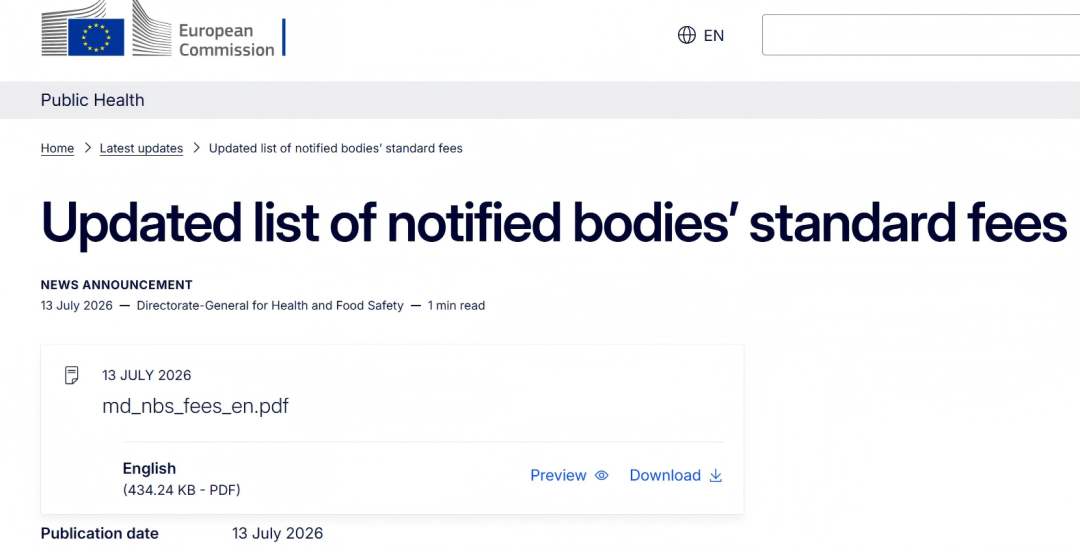
The published materials are provided in official PDF format and include direct links to the fee schedules available on the websites of compliant NBs worldwide, covering major organizations such as DNV, Eurofins, SGS, TÜV, Berlin Cert, and Certiquality.
The publication clarifies the requirement for compliant NBs to make their complete conformity assessment fee structures publicly available, implementing the transparency requirements set out in Article 50 of the MDR and Article 46 of the IVDR, together with the implementation guidance provided in MDCG 2023-2.
For years, one of the most common challenges faced by Chinese medical device manufacturers has been the lack of transparency in CE certification pricing. Companies may initially receive a low quotation only to encounter additional travel expenses, reassessment fees, supplementary document review fees, and other charges during the assessment process. In some cases, the final cost can be 30%–50% higher than the original quotation.
With no standardized basis for comparing fees across different NBs, manufacturers have often had to rely heavily on industry experience when selecting a certification body.
The EU’s centralized publication of NB fee information now brings these pricing practices into greater transparency.
1. Why Does the EU Require NBs to Publish Their Fees?
Mandatory regulatory requirements
Article 50 of the MDR and Article 46 of the IVDR establish requirements for NBs concerning conformity assessment fee schedules, including the obligation to make relevant pricing information publicly available.
MDCG 2023-2 further emphasizes transparency in NB fees, including the need for fee information to be readily accessible rather than concealed behind registration requirements or requests for contact information.
Alignment with the major 2026 regulatory development: EU 2026/977
The EU implementing regulation on NB oversight introduced in May this year establishes two key principles concerning fee transparency:
- NB quotations must be itemized. Fees for application processing, ISO 13485 quality management system audits, technical documentation review, clinical evaluation report (CER) assessment, on-site audits, unannounced audits, annual certificate fees, and reassessment of changes should be clearly identified as separate items.
- Significant increases in the estimated total cost must be communicated in advance. Where the final cost is expected to exceed the initial estimate by more than 10%, the NB must notify the manufacturer in writing in advance and explain the reasons for the increase, rather than imposing unjustified additional charges.
The centralized publication on July 13 therefore represents an important step toward implementing three objectives simultaneously: greater pricing transparency, greater standardization of quotations, and tighter control over additional charges.
Together, these measures create a regulatory framework based on regulatory requirements + centralized official information + public accessibility.
Supporting SMEs
The regulatory framework also takes into account EU policies aimed at reducing the compliance burden on small and medium-sized enterprises (SMEs).
A number of NBs separately identify preferential fee rates or discounts for eligible micro, small, and medium-sized enterprises in their published fee schedules. Smaller Chinese manufacturers exporting to the EU can therefore compare the available options and identify NBs offering applicable preferential rates, potentially reducing overall compliance costs.
2. Overview of NB Fee Ranges
2026 reference ranges based on publicly available fee schedules
Based on the fee information included in the EU’s consolidated list, the following table summarizes indicative fee ranges for several conformity assessment activities frequently undertaken by Chinese medical device manufacturers.
| Assessment Item | Typical Fee Range | Notes |
|---|---|---|
| Certification application fee | €1,200–€3,500 | Charged separately for initial certification and recertification |
| QMS audit | €180–€440/hour | Includes document review and on-site audit; travel expenses are generally charged separately at actual cost |
| Technical documentation + clinical evaluation review | €200–€545/hour | Class IIb and Class III devices generally require more extensive review and therefore incur higher costs |
| Certificate issuance fee | €100–€1,300/certificate | Often charged by product family; bundling multiple models may be more cost-effective |
| Unannounced audit | €2,880–€9,000/audit | Random inspections, with applicable fees specified in the NB’s published fee schedule |
Indicative total certification costs by device class
The following figures are indicative NB conformity assessment fees only and do not include testing, clinical investigations, EU Authorized Representative services, regulatory consulting, or other third-party costs:
- Class IIa standard devices: €3,000–€10,000
- Class IIb higher-risk devices: €10,000–€30,000
- Class III implantable or active devices: from approximately €15,000, with complex products potentially reaching several hundred thousand euros.
NB fee levels can vary significantly by country and by individual conformity assessment scope. The applicable fee should always be confirmed against the relevant NB’s officially published fee schedule.
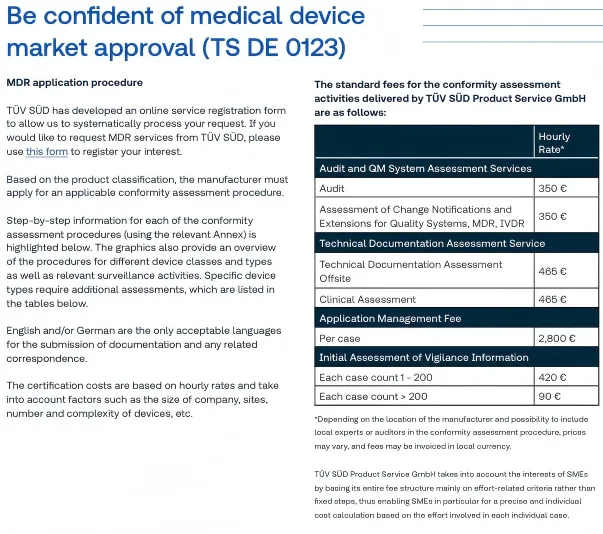
TÜV SÜD Product Service (NB 0123) — excerpt from its published fee schedule
3. Five Key Benefits for Chinese Medical Device Manufacturers
1. Compare NBs based on official information rather than word of mouth
When approaching multiple NBs for quotations, manufacturers can compare the quotations they receive against the original fee schedules published through official EU channels.
This makes it easier to determine whether a quotation is consistent with the NB’s published pricing, whether any items have been omitted, and whether additional charges have been introduced that are not reflected in the published fee schedule.
2. Greater protection against “low initial quotes followed by additional charges”
If a particular fee is not included in an NB’s published fee schedule, manufacturers can use the published information as a reference when challenging unexpected charges during the assessment process.
Where the overall cost increases significantly beyond the initial estimate, manufacturers can request an explanation and supporting justification from the NB. Where appropriate, non-compliant practices may also be subject to regulatory scrutiny.
3. More accurate budgeting and long-term compliance planning
For manufacturers developing three- to five-year EU market strategies or planning new product launches, publicly available hourly rates, annual surveillance fees, recertification fees, and other assessment costs provide a more reliable basis for estimating long-term regulatory expenditure.
This can reduce the need to set aside large contingency budgets for potentially unpredictable certification-related expenses.
4. Potential fee advantages for SMEs
Several NBs identify preferential rates for eligible SMEs in their published fee schedules.
Chinese small and medium-sized manufacturers that meet the applicable eligibility criteria can proactively provide supporting information and determine whether they qualify for reduced assessment fees, potentially lowering the cost of entering the EU market.
5. Greater flexibility when changing Notified Bodies
If a manufacturer is dissatisfied with its existing NB due to service quality, unclear pricing, or other issues, the official list provides a convenient starting point for comparing alternative compliant NBs.
Manufacturers can assess the expected costs of transferring certification, recertification, and related conformity assessment activities before making a decision, making the NB selection process more transparent and manageable.
After years of MDR implementation, EU regulatory requirements and conformity assessment scrutiny continue to become increasingly stringent.
The official publication of NB fee information on July 13 addresses another important aspect of the conformity assessment process: stricter assessments, clearer procedures, and greater pricing transparency.
For Chinese medical device manufacturers seeking CE certification under the MDR or IVDR, understanding how NB fees are structured—and comparing quotations against publicly available fee schedules—can provide a more informed basis for selecting an appropriate conformity assessment partner and planning EU compliance costs.
Official EU Fee Schedule
The official EU document containing the relevant NB fee information can be accessed here:
European Commission — Medical Device Notified Bodies Fee Schedules (PDF)