
On 9 September 2026, the Medical Device Coordination Group (MDCG) published MDCG 2020-16 rev.5 — “Guidance on Classification Rules for in Vitro Diagnostic Medical Devices under Regulation (EU) 2017/746”. According to the revision history, the update focuses on Rule 7, which further clarifies the criteria for determining whether a quality control material carries an assigned quantitative or qualitative value, and revises the corresponding examples.
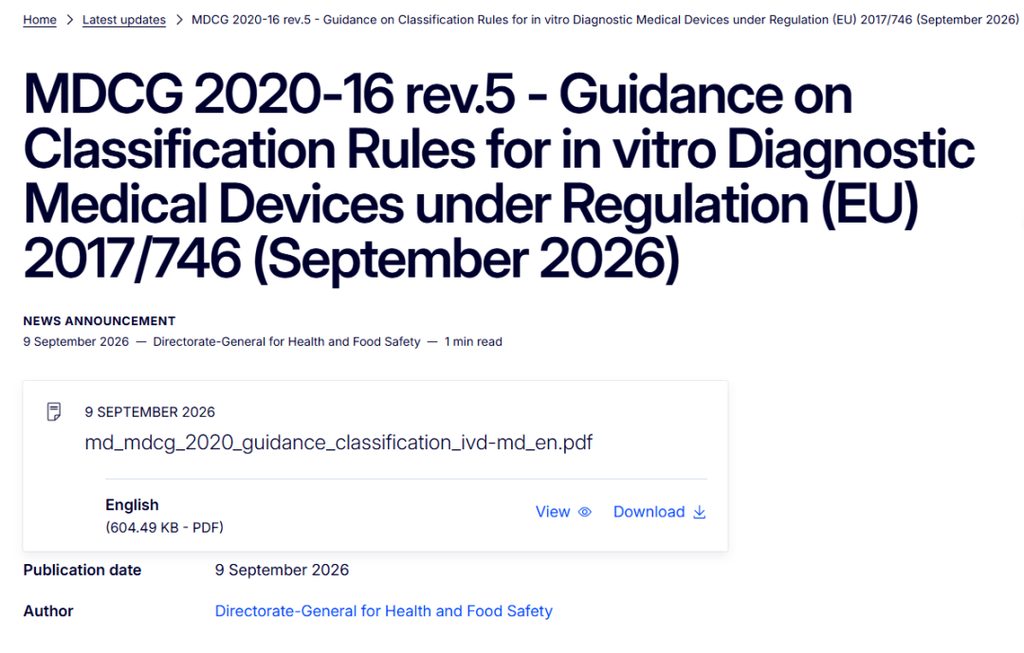
Source: MDCG 2020-16 rev.5 — health.ec.europa.eu/latest-updates/mdcg-2020-16-rev5-guidance-classification-rules-vitro-diagnostic-medical-devices-under-regulation-eu-2026-09-09_en
1. Intended Use of Standalone Quality Control Materials Further Clarified
The revised guidance explains that standalone quality control (QC) materials may be used to monitor the validity of laboratory testing procedures, helping laboratories to continuously confirm their test results and the performance of their equipment. However, the manufacturer must clearly state in the instructions for use (IFU):
| # | Statement Required in the IFU | Regulatory Rationale |
| 1 | The product is intended solely to monitor the validity of laboratory testing procedures. | Prevents the product from being presented as a substitute for reagent- or instrument-manufacturer supplied QC materials. |
| 2 | The product does not replace the mandatory QC materials required by the reagent or instrument manufacturer. | Reinforces that standalone QC is supplementary and cannot substitute for the mandatory QC needed to verify IVD performance. |
| 3 | The product possesses performance characteristics suitable for the corresponding IVD examination method. | Demonstrates fitness for the intended in vitro diagnostic examination method being monitored. |
To demonstrate that a standalone QC material is suitable for a specific examination method, the manufacturer may provide information on the presence of the relevant analyte or its concentration range. Provided that the target values actually used by the laboratory are not specified by the manufacturer, such information does not generally constitute an “assigned value”. The product may therefore remain classified as Class B under Rule 7, except where other classification rules apply.
| KEY INTERPRETATIONA manufacturer-stated presence indication or concentration range does not, by itself, convert a control into an “assigned value” control.The decisive test is whether the manufacturer specifies the target value that the laboratory is to use. If the laboratory determines its own target values, Rule 7 remains applicable. |
2. Assigned-Value Quality Control Materials Are Outside the Scope of Rule 7
Where a quality control material is assigned a quantitative or qualitative value by the manufacturer — including controls used to determine the validity of a test kit — Rule 7 does not apply. Such products are classified in accordance with implementing rule 1.6 of the IVDR, under which quality control materials assigned a value by the manufacturer for a specific analyte or a panel of analytes are classified in the same class as the device they control.
| Control Material | Classification Route | Typical Class |
| Unassigned QC** (no manufacturer-assigned value) | Rule 7 | Class B |
| Assigned QC** used with a Class B reagent kit | Implementing rule 1.6 | Class B |
| Assigned QC** used with a Class C reagent kit | Implementing rule 1.6 | Class C |
| Assigned QC** used with a Class D reagent kit | Implementing rule 1.6 | Class D |
In other words, assigned quality control materials intended for use with Class B, C or D reagent kits are generally managed as Class B, C or D respectively.
3. Examples Under Rule 7
The following are given in the revised guidance as examples of Class B quality control materials (the list is non-exhaustive):
| # | Example (Class B Quality Control Material) | Monitoring Purpose |
| 1 | Unassigned control sera. | General-purpose, non-assay-specific control. |
| 2 | Control materials used to verify the migration of immunochromatographic assays. | Verifies migration behaviour in immunochromatographic assays. |
| 3 | Unassigned QC material used as a heterozygous quality control to monitor analytical performance of the extraction, amplification and detection of nucleic acids. | Monitors extraction, amplification and detection performance in nucleic acid workflows. |
| 4 | Non-assay-specific control plasma for use in coagulation. | Non-assay-specific control for coagulation assays. |
| 5 | Non-assay-specific control serum containing multiple biochemical analytes. | Multi-analyte, non-assay-specific control. |
| 6 | A DNA or RNA probe supplied for use as a non-assay-specific normal control for in situ hybridisation (ISH). | Non-assay-specific normal control for in situ hybridisation. |
The document further reiterates that, pursuant to Article 1(3)(c) and 1(3)(d) of the IVDR, “internationally certified reference materials” and “materials used for external quality assessment schemes” are not in vitro diagnostic devices.
4. Rule 7 Before and After the Revision
The table below sets out the changes introduced by rev.5 to the text of Rule 7.
| Element | Before (rev.4) | After (rev.5) |
| Scope of the rule | Applies to controls “described as un-assayed”, where control values are assigned by the user and not the manufacturer. | Applies to controls without an assigned value, intended by their manufacturers to be used in IVD procedures. |
| Permitted manufacturer information | The manufacturer may indicate whether a specific analyte is present or absent, without indicating expected assay results. | The manufacturer may indicate the range of values for each parameter in the IFU; the target values routinely used are those determined by the medical laboratory, not those indicated by the manufacturer. |
| Role of standalone QC materials | Not addressed. | Explicitly recognised: standalone QC materials may be used alongside reagent or instrument manufacturer control materials to validate equipment performance and monitor result validity. |
| Limits of use | Not addressed. | The intended purpose must be limited to monitoring the validity of laboratory examination procedures; such materials cannot replace the mandatory QC materials required to verify IVD performance. |
| Suitability for the method | Not addressed. | Standalone QC materials must possess properties suitable for the in vitro diagnostic specific examination method being monitored; presence or concentration range information may be provided by the manufacturer. |
| Treatment of stated values | Not addressed. | Values indicated by the manufacturer of standalone QC materials are expressly not considered “assigned values”; the product is classified as Class B under Rule 7 unless other rules apply. |
| Assigned-value controls | Classified according to implementing rule 1.6. | Unchanged — controls with manufacturer-assigned quantitative or qualitative values, including assay kit validity controls, are classified according to implementing rule 1.6. |
| Non-IVD materials | Reference to Article 1(3)(c) and 3(d). | Unchanged, with the paragraph reference clarified to “Article 1 paragraph 3(c) and paragraph 3(d)”. |
| Examples | Six non-exhaustive examples, including “unassigned QC material as a heterozygous quality control”. | Same six examples retained; wording refined and the nucleic acid example now explicitly refers to “extraction, amplification and detection of nucleic acids”. |
5. Recommendations for Medical Device Companies
For quality control material submissions, companies should verify the numerical statements in the instructions for use in order to clearly distinguish a “reference range” from a “manufacturer-assigned value”, and state whether the product is specific to a particular reagent or instrument, and whether it is intended to determine the validity of a specific testing system.
- Verify the numerical language in the IFU. Clearly distinguish a stated reference range from a manufacturer-assigned value. Confirm whether the product targets a specific reagent or instrument, and whether it is used to determine the validity of a specific testing system.
- Define the intended use narrowly where the product is unassigned. Where the product is an unassigned standalone QC material, clearly limit its intended use to monitoring the validity of laboratory testing procedures, and avoid any positioning that could confuse it with assigned QC materials or with assay-kit validity controls.
- Confirm the classification route before submission. If any value is assigned by the manufacturer, or the control is used to validate a test kit, Rule 7 is not available and implementing rule 1.6 applies instead.
- Align labelling with the mandatory IFU statements. The three statements set out in Section 1 should be reflected consistently in the labelling, instructions for use and technical documentation.
Article Information
Bibliographic record and title-derived keywords. This section is reference metadata for the article above; it does not add further analysis.
| Field | Detail |
| Original title | 欧盟IVD分类指南Rule 7更新 |
| Original language | Chinese (Simplified) |
| Publisher | GRZAN 国瑞中安 — WeChat official account 国瑞中安法规资讯 |
| Publication date | 10 September 2026 |
| Source article | https://mp.weixin.qq.com/s/9ErLx0gItDs47dHm0YIxcQ |
| Regulator / Issuer | Medical Device Coordination Group (MDCG), European Commission |
| Legal instrument | Regulation (EU) 2017/746 (IVDR) |
| Official reference | MDCG 2020-16 rev.5 — Guidance on Classification Rules for in Vitro Diagnostic Medical Devices |
| Topics | IVD classification; Rule 7; quality control materials; standalone QC; implementing rule 1.6 |
| Document type | Regulatory news summary — English translation of the source article |
Summary
A short regulatory news item reporting the publication of MDCG 2020-16 rev.5 and the focus of the revision on Rule 7. It is provided as a translation aid and orientation only; the MDCG guidance and the IVDR are the authoritative sources.