
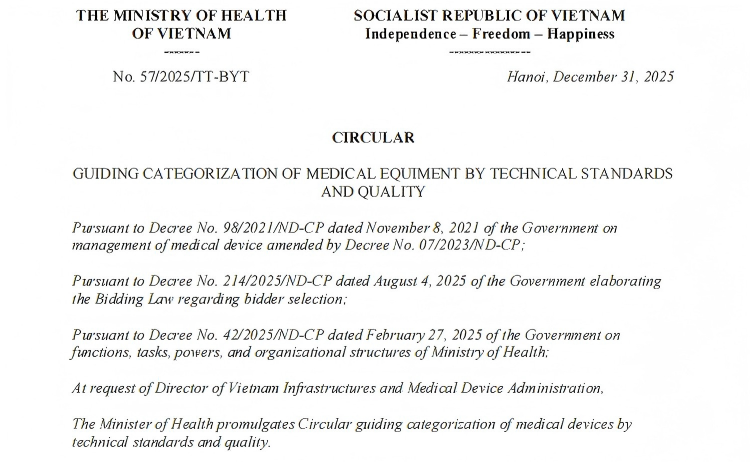
Recently, the Vietnamese Ministry of Health (MOH) officially promulgated Circular No. 57/2025/TT-BYT, aiming to establish a clear, transparent, and evidence-based classification system for medical device procurement and tendering.
The regulation will enter into force on 15 February 2026 and will be formally implemented from 1 January 2027. This reform is expected to reshape the competitive landscape for medical device companies operating in the Vietnamese market.
I. Core of the New Regulation: Six Groups Based on “Technical Standards” and “Quality”
The key feature of the Circular is that, in future medical device tenders, products will no longer compete within a single undifferentiated pool. Instead, they will be classified into six distinct groups based on two objective criteria—technical standards and quality—thereby enabling tiered competition.
1. The Two Classification Criteria
(1) Technical Standards
The regulation recognizes compliance with national standards, international standards, and equivalent specifications. Methods of demonstrating conformity are categorized into three levels, from most to least stringent:
- a) Certification:
Obtaining conformity certification as required by Vietnamese regulations (most stringent) - b) Assessment:
Submission of assessment results issued by a legally recognized conformity assessment body - c) Self-declaration:
Submission of supporting documentation provided by the device owner (least stringent)
(2) Quality Certification
Quality certification refers to the product having obtained marketing authorization in at least one country or jurisdiction.
Crucially, the Circular’s annex introduces a “Golden List” of recognized regulatory authorities. Approvals granted by authorities on this list carry significantly higher regulatory value in the classification process.
2. Detailed Six-Tier Classification Table
The table below outlines the specific requirements for each of the six groups. Lower group numbers indicate stricter requirements.
“On-List” refers to approvals issued by regulatory authorities included in the Annex “Golden List,” which comprises nine recognized countries/jurisdictions.
Six-Group Classification Framework
| Group | Technical Standard Requirement (Method of Conformity) | Quality Certification Requirement (Approval Source) | Interpretation |
|---|---|---|---|
| Group 1 | a (Certification) | On Golden List | Highest standard; dual stringent requirements |
| Group 2 | a (Certification) | Off Golden List | Strict technical standards; broader quality source |
| Group 3 | a or b (Certification or Assessment) | On Golden List | Moderate standards; high quality threshold |
| Group 4 | a or b (Certification or Assessment) | Off Golden List | Medium-level requirements |
| Group 5 | a, b, or c (Any) | On Golden List | Flexible technical standards; high quality threshold |
| Group 6 | a, b, or c (Any) | Off Golden List | Lowest entry requirements |
II. The Critical “Golden List” of Reference Authorities
A key annex to the Circular establishes a “Golden List” consisting of nine globally recognized, stringent regulatory authorities, as detailed below:
“Golden List” (9 Authorities)
- United States: Food and Drug Administration (FDA)
- Australia: Therapeutic Goods Administration (TGA)
- Canada: Health Canada
- Japan: Ministry of Health, Labour and Welfare (MHLW) or Pharmaceuticals and Medical Devices Agency (PMDA)
- European Union: Competent Authorities of EU Member States
- United Kingdom: Relevant Competent Authorities
- Switzerland: Relevant Competent Authorities
- China: National Medical Products Administration (NMPA)
- South Korea: Ministry of Food and Drug Safety (MFDS) or National Institute of Medical Device Safety Information (NIDS)
Regulatory Significance
The inclusion of the “Golden List” carries substantial strategic implications. Medical devices that have already obtained marketing authorization from any one of the listed authorities automatically meet the high-level “quality” criterion for upper-tier groups (e.g., Groups 1, 3, and 5).
In practice, this functions as a fast-track credential to Vietnam’s higher-end procurement market, significantly enhancing a product’s competitive positioning in public tenders.